
Tuesday, April 26, 2011


Wednesday, March 16, 2011
Be prepared and informed when an emergency incident occurs in the county
We are publishing this press release to encourage all to sign up for code red from the office of emergency managment. stay informed and be prepared when an emergency incideent occurs in grand county. see details below:
Contact Person: Cpt. Nowell Curran 970-509-9500 ncurran@co.grand.co.us
The Office of Emergency Management wants to talk to you
The Grand County Office of Emergency Management (OEM) is proud to announce the public information and warning systems established to provide urgent emergency information to the community. Information provided by Emergency Management enables residents and visitors to be prepared and informed when an emergency incident occurs in the county. Due to the geographically challenging area we live in, no single method of notification works for everyone. This has resulted in, OEM, incorporating several different tools that can be utilized to obtain necessary public information and warning.
www.gcemergency.com is a web site that is managed by the OEM. It provides up-to-the-minute emergency notification and information concerning incidents that affect the community. This site helps instruct and inform residents and visitors of what to do, where to go, or what they need in the case of an emergency.
Code Red is a communication tool that works for cells phones as Reverse 911 works for landlines. This service has been especially beneficial to community members and second home owners who may not have a landline phone in their home. In times of evacuation, fire, hazardous material spills, shelters, and drinking water contaminations, the CodeRED system will call your registered mobile phone and playback a recorded message from the Grand County Office of Emergency Management. It can also send text and/or email to inform you of the incident and important instructions to follow. This tool was especially helpful to the Kremmling residents during the water contamination incident in September of 2009. Community residents who were registered were informed of where they could pick up potable water during the crisis and when the water was again safe to drink.
Along with these two communication resources the Office of Emergency Management was awarded two variable message sign boards through a state grant that can be positioned in areas throughout the county. These signs can be used to inform the public of open shelters, flu clinics, evacuations and other urgent situations. In addition to these mobile boards OEM will be placing indoor scrolling messaging boards which will be located in known public gathering places throughout Grand County. The above notification systems are tools that OEM has purchased and maintains to notify the public. These notification systems that OEM uses are provided to the county, free of charge as a public service to the community.
These are all communication tools for the Office of Emergency Management to get the “word” out. There is another available resource for the community to provide helpful information. This is 211 United Way. Through the 211 call center, community members may register so that responders can identify and be prepared to contact people who may not have a vehicle, are on Oxygen or a ventilator, or may be immobilized whether temporarily or permanently.
Residents and visitors can also be informed by the National Weather Service Civil Emergency Message (CEM) broadcast. These messages are requested through the Office of Emergency Management and would broadcast through the NOAA weather radio in the west end of the county, where it is only currently available. The Civil Emergency message will be passed on to TV and Radio stations which would then inform the public either through the radio DJ or a scrolling message at the bottom of your television screen.
The priority and primary goal of the OEM is to keep people safe, knowledgeable and informed in emergency situations. To accomplish that, OEM constantly strives to implement the most up-to-date communication methods available to get the information to the public. OEM encourages community members and stakeholders to utilize these tools that are available to them to help reach a better state of readiness. Registration is made easy through the web link www.gcemergency.com for all of these tools. Or the Grand County Office of Emergency Management is also available to assist with questions or help in registering at (970) 887-2732.
Tuesday, March 15, 2011
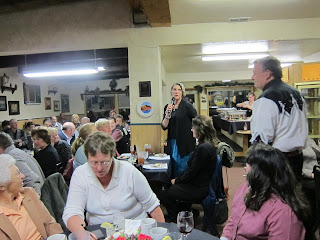
Pictures from the 2011 Middle Park Medical Foundation Dinner
Pictures from the 2011 Middle Park Medical Foundation Dinner









Friday, February 11, 2011
Can babies be delivered in Grand County? (as published in Sky Hi News 2-11-2011
Hello, Eric. I was wondering if there is going to be a delivery service at the new medical center? It would really be nice to not have to go to Denver to have a baby.
The short answer is that it’s possible if there is an emergency, but only in emergency situations. The new facility won’t be able to provide obstetrical services. Granby Medical can also deliver on an emergency basis only as well as the hospital in Kremmling. But as far as planned deliveries, expecting parents will still need to make arrangements elsewhere. For the health of the mom and of the baby, parents need to plan to be at a hospital that is well equipped and has well trained professionals to handle any situation for the delivery of their baby.
The reasons for not being able to offer planned deliveries involve many variables, and unfortunately they just don’t add up to justify the service. Let’s take a quick look at why delivering babies is a service that won’t likely happen for many years, if ever, by local health care providers in Grand County.
According to studies, Grand County has approximately 100 babies born per year within our 1,850 square miles of territory. Even if we offered it as a service, to-be moms and dads who reside here might still choose to have their babies at healthcare facilities in Steamboat Springs, Estes Park, Summit County or Denver. The number of potential monthly deliveries would fall considerably short of the cost to keep the clinicians trained and available around the clock, (because we all know babies decide to be born on their own time, often in the middle of the night and on weekends).
Only ten possible births in Grand County per month is just not enough to keep the highly specialized staff that would be needed to ensure the health of both baby and mother. Some break-even estimates a healthcare facility to provide the service is upwards of 40-100 per month and many of those programs are heavily subsidized. Even then, many are closing due to every increasing liability, demands for expensive equipment and constant training and re-training.
So what can expecting mothers in Grand County do? Several local physicians offer prenatal care, from the time a woman learns she is pregnant up to the birth. Pediatric care after the child is born is also readily available.
Pre-natal care including regular check-ups and a plan is important. Several physicians offer these services which include regular visits so the doctor can listen to the baby’s and the mother’s heartbeat, measurement of the growth of the belly, female checks, urine checks, regular monitoring of blood pressure and conversations with mothers on what to expect every step of the way.
*Note: some information regarding who provides pre-natal care was published, mistakenly in the last paragraph, not included above.
Tuesday, February 8, 2011
Medication errors averted
Taking the correct medicine in the correct dosage is important—obviously. But mistakes can happen at home, as well as in medical facilities and the results can mean discomfort from side-effects, an allergic reaction or even death.
Take for instance, the morning when I woke up with a splitting headache. With eyes squinted in anguish and further irritated from the sunlight shining through my bedroom window, I stumbled to the medicine cabinet. Only able to crack open a single eye just enough to read the word, “Tylenol”, I hastily grabbed the bottle and fumbled to open the lid. I dumped three pills into my hand and foolishly reasoned that my headache was so bad I could take the extra pill, against the recommended dosage of two, in order to really knock this head-splitter out fast so I could get to work.
This was an especially bad idea considering the fact which I would soon learn with much disappointment. As I brushed my teeth and looked at the bottle again, this time with both eyes fully open, I realized that the three Tylenol I took were actually Tylenol PM, the nighttime, help-you-sleep-quick kind. I had just swallowed three of them early in the morning, before work!
Needless to say my day was a battle of fighting off a strong need to sleep throughout driving, meetings, answering phone calls and tying to complete projects. There was a lot of uncontrollable drooling and head teetering.
Medication errors in hospitals across the nation can have grave consequences. Mistakes can be a result of several factors including misreading labels, misunderstanding drug abbreviations, misunderstanding allergies, lab tests or misreading hand-written notes regarding the patient’s condition or other special instructions. Environmental factors such as poor lighting, heat, noise can be causes of mistakes.
Another reason might be multi tasking and interruptions while a health care professional is administering medications. To prevent this possibility, hospitals such as Kremmling Memorial, have implemented a simple, yet effective strategy, “Non-Interruption Wear”. It is made known to all hospital staff, that when a nurse is wearing an orange satchel, the nurse is not to be interrupted. The brightly colored sash provides a visual reminder to others that the nurse is busy carrying out the critical task of administering medication to a patient.
“This is working well,” said
Decreasing the number of interruptions during this critical task allows the nurse to focus solely on the administration of the medication. “This is a simple but mandatory requirement we have implemented to meet one of our National Patient Safety Goals: Safe Medication Administration.” indicates Carmen
In 1980 there were about 600 medications that were commonly administered to patients in health care settings. Today that number exceeds 10,000 different medications, dosages, and administration routes. The nurse must have a working knowledge of the reason for taking a medication, the physiologic actions a medication has on the body, the potential side effects for the patient based on a variety of patient risk factors, and the patient’s expected reaction to a medication.
Nurses do this in addition to the many other aspects of their daily duties and responsibilities to ensure the provision of safe patient care. So actions we can take to decrease distractions for the nurse will aid them in their effort to administer the right medications to the right patient, at the right time, in the right dose, and the right route to deliver safe patient care.
Patients can also be pro-active in the safety of their medications. Start by asking questions to improve understanding of why certain medications are prescribed. It is also wise to ask for a printed out copy of your prescription along with the reason for taking it, when to take it and the dosage.
Every time a patient goes in to see a doctor, this list should be shared with the physician. Better yet, grab a paper bag, toss in all of your bottles of medications, vitamins and even herbs and show your doctor what you have been taking. These simple, yet effective measures for taking medicine at home, along with the measures taken by hospital medical staff during a hospital stay, both improve safety of taking medication.
Subscribe to:
Posts (Atom)